


Residential car lift installation is simpler than most homeowners expect — but only when the garage is ready. A prepared garage with adequate ceiling height, solid concrete, and the right electrical circuit turns installation into a one-day project. An unprepared garage turns it into a multi-week headache involving electricians, concrete contractors, and return trips.
At Auto Lift Services, we sell and ship home garage lifts nationwide, and we walk every buyer through the installation requirements before they purchase. This guide covers every factor that affects residential car lift installation: concrete, electrical, clearance, permits, and the realistic timeline from delivery to first use.
Concrete Requirements
Your garage floor is the foundation for every pound the lift holds. Concrete that works for parking cars is not automatically adequate for anchoring a lift loaded with 8,000 pounds.
Slab Thickness
Most home garage lifts require a minimum 4-inch concrete slab. Standard residential construction in most of the United States pours garage slabs at 4 inches — so the majority of existing garages meet this requirement without modification.
How to check: If your garage was built to code in the last 40 years, the slab is almost certainly 4 inches. If you are unsure — older homes, rural construction, or DIY garages — drill a small test hole near where the lift will sit. A masonry bit through the slab tells you the thickness in 30 seconds. Patch the hole with hydraulic cement.
Slab Condition
Thickness is not the only factor. The concrete needs to be structurally sound where the anchor bolts will go.
Cracks. Hairline surface cracks from normal curing are fine. Wide cracks (over 1/4 inch), deep cracks that go through the slab, or cracks radiating from a central point suggest structural issues. If a lift column base sits over a major crack, the anchor bolts may not hold properly under load.
Settling. Sections of slab that have sunk, tilted, or heaved create problems for residential car lift installation because the lift must sit level. Columns that are not plumb and level put uneven stress on the lift structure. Minor settling (under 1/4 inch across the lift footprint) can be shimmed. Significant settling may require mudjacking or a new pad.
Surface condition. Epoxy coatings, paint, and sealers on the concrete surface do not affect installation — the anchor bolts go through any surface treatment into the concrete below.
If Your Concrete Is Not Adequate
Two options: pour new pads under each column position (typically 24×24 inches, 6 inches thick, reinforced with rebar), or pour a new full slab. Column pads run $500 to $1,500 per pad depending on your area. A full new slab for a two-car garage runs $3,000 to $6,000. In most cases, pads are sufficient and cost-effective.
Electrical Preparation
The electrical requirement depends entirely on the lift model.
110V Lifts (Atlas PRO8000 Series)
Atlas storage lifts run on 110V/30A — the same voltage as every standard outlet in your home, but at a higher amperage than a typical 15A or 20A outlet. Most residential car lift installation projects with Atlas lifts need one of two things:
Option A — Dedicated 30A circuit. Your electrical panel has an open slot, and an electrician runs a new 30A circuit to the lift location with a NEMA 14-30 or L5-30 outlet. Cost: $200 to $500 depending on distance from panel to lift.
Option B — Existing 30A circuit. Some garages already have a 30A circuit for a window air conditioner, large power tool, or spare outlet. If the circuit is not shared with other high-draw equipment, it may work. Have an electrician verify the circuit capacity and outlet type.
220V Lifts (BendPak HD-9 Series)
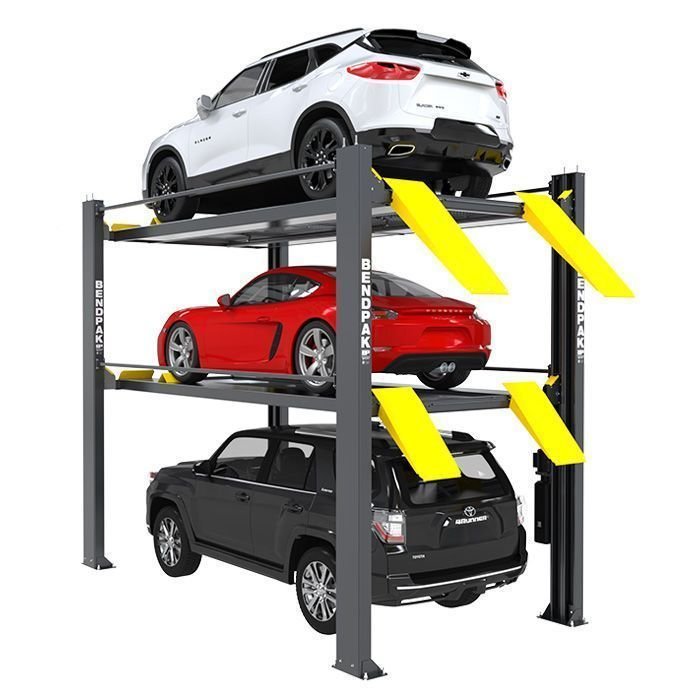
BendPak HD-9 lifts require 220V single-phase power — the same type of circuit that runs a clothes dryer, electric range, or welding machine. Many garages do not have a 220V circuit, so this is a common addition during residential car lift installation.
An electrician runs a new 220V/30A circuit from your main panel to the lift location. If your panel has an open double-pole breaker slot and the garage is attached to the house, this typically costs $300 to $800. Detached garages with a subpanel may cost more. Garages with no existing subpanel that need a new one are looking at $1,000 to $2,000 for panel installation plus the circuit.
BendPak HD-9 lifts also require a small air supply — 30 PSI at 3 CFM — for the air-lock safety mechanism. A small pancake compressor or portable inflator that maintains 30 PSI is sufficient. Many homeowners already have a suitable compressor. If not, budget $100 to $300 for a basic shop compressor.
Garage Door Clearance
The lift sits behind the garage door — further into the garage than the door’s overhead track. Three clearance checks matter for residential car lift installation:
Door track clearance. When the garage door is open, it rides along a horizontal track near the ceiling. The lift columns and any raised vehicle must not contact this track. Measure the distance from the back edge of the horizontal track to the wall behind it — that is your available depth for the lift.
Door height clearance. When the door is closed, the top of the door opening defines the maximum height of anything that can enter the garage. The lift, when lowered, must allow vehicles to drive in. All standard 4-post lifts sit low enough that vehicles drive over the runways (the runways are only 5-6 inches off the floor when lowered).
Opener clearance. If your garage door opener is a ceiling-mount unit (the most common type), it hangs below the ceiling by 6 to 12 inches. This reduces your effective ceiling height in that zone. The lift itself can go behind the opener, but if the opener is positioned where a lift column needs to go, you may need to relocate it. A jackshaft (wall-mount) opener eliminates this conflict entirely — they mount beside the door at head height and leave the ceiling completely clear.
Permits and Local Code
Here is the good news for residential car lift installation: most jurisdictions do not require a building permit for installing a car storage lift in an existing residential garage. A 4-post lift sits on the floor (on casters or with anchor bolts) and plugs into an electrical outlet. It does not modify the structure, does not change the roofline, and does not alter the building’s footprint.
When permits may be required:
- If you are running a new electrical circuit, some jurisdictions require an electrical permit. Your electrician typically handles this — it is a standard residential electrical permit, not a special lift permit.
- If you are pouring new concrete pads, some jurisdictions require a permit for any concrete work over a certain square footage.
- If you live in a flood zone or special assessment district, any modification to the garage floor may require review.
- If the lift installation is part of a larger garage renovation (new walls, new slab, structural changes), the renovation may need a permit even if the lift itself does not.
HOA considerations. Homeowner associations cannot see inside your closed garage, and most HOA covenants do not address interior garage equipment. However, some HOAs restrict “commercial activity” in residential properties — if your garage lift is visible from the street (open-door parking), or if neighbors report that you are running a repair business from your home, the HOA may have grounds for complaint. Keep the door closed and the hobby private, and this is a non-issue.
DIY Installation vs. Professional
What DIY Residential Car Lift Installation Involves
The lift arrives on a freight pallet — typically one or two crates containing columns, runways, hardware, hydraulic power unit, and instructions. Assembly requires:
Tools: Socket set, wrenches, hammer drill with concrete bits (for anchor bolts), torque wrench, level, tape measure, and a second pair of hands. The columns are heavy — two people minimum for standing them up and positioning them.
Skills: If you can assemble furniture from a hardware store, read a technical manual, and drill into concrete, you can install a 4-post home garage lift. The assembly is mechanical — bolt A to bracket B, torque to spec, connect hydraulic lines, wire the power unit. No welding, no fabrication, no structural engineering.
Time: 4 to 8 hours for most 4-post storage lifts with two people. First-timers trend toward 8 hours. Experienced DIYers or anyone who has assembled heavy equipment before trend toward 4 to 5 hours.
Critical steps: Column alignment (columns must be plumb and square to each other), anchor bolt torquing (under-torqued anchors are a safety hazard), hydraulic system bleeding (air in the lines causes uneven rise), and lock verification (test every lock position with the lift empty before putting a vehicle on it).
When to Hire a Professional
Hire a professional for residential car lift installation if:
- You are not comfortable drilling anchor bolts into concrete
- Your garage floor has condition issues that require evaluation
- The lift requires electrical work beyond your skill level
- You want the installation warranted by the installer
- You do not have a second person to help with the heavy components
Professional installation for a 4-post home garage lift typically runs $500 to $2,000 depending on your location and the complexity of the job. We can recommend installation partners in your area — call us with your zip code and we will connect you.
Common Installation Mistakes
Not measuring ceiling height to the lowest obstruction. Measuring floor to ceiling instead of floor to garage door opener/track/light fixture. Read our garage ceiling height guide and measure correctly before buying.
Skipping the anchor bolts. Some lifts come with casters and can be positioned without anchoring. Homeowners skip the anchor bolts to keep the installation “temporary.” Under load, an unanchored lift can shift, tilt, or walk — especially on smooth epoxy-coated floors. If the manufacturer recommends anchoring, anchor it.
Using the wrong concrete anchors. The manufacturer specifies anchor bolt diameter, length, and type. Substituting shorter bolts, thinner bolts, or expansion anchors when wedge anchors are specified compromises the installation. Use exactly what the manual calls for.
Not testing the lock mechanism at every position. Raise the lift empty to each lock position. Verify that the locks engage fully, that both sides lock simultaneously, and that the manual release operates correctly. Do this before the first vehicle goes on.
Timeline: Order to First Use
- Order and shipping: 1 to 2 weeks for delivery via freight carrier
- Electrical prep (if needed): Schedule an electrician — 1 to 3 weeks lead time, 2 to 4 hours on-site
- Concrete evaluation (if needed): Same-week in most areas
- Assembly: 1 day (4-8 hours)
- Testing and first vehicle: Same day as assembly
Total realistic timeline for residential car lift installation: 2 to 4 weeks from order to driving your first car onto the lift. Most of that time is shipping and scheduling — the actual installation is a single day.
We Ship Nationwide and Support Every Installation
Auto Lift Services delivers home garage lifts to all 50 states. Every lift includes manufacturer documentation, and our team answers installation questions by phone before, during, and after the project.
Shop home garage lifts at store.autoliftserv.com. Need help choosing a lift or planning your installation? Call 800-674-9302 or email [email protected].
Related reading:
– Home Garage Car Lift — Complete Guide
– Garage Ceiling Height for Car Lift — What You Need
– Home Garage Lift Cost — Full Project Breakdown

Josiah Ragsdale
Founder, Automotive Lift Services
Josiah has been installing, repairing, and inspecting automotive lifts since he was 18 years old. He founded Automotive Lift Services in 2019 after years of seeing lifts installed wrong, never inspected, and putting technicians at risk. His team now services all 50 states from their Iowa headquarters. Read more
Car Lift In Garage Residential – Questions & Answers
Are your lifts ALI certified?
We sell ALI-certified lifts. Certification matters for safety and for your insurance and inspections.
What comes in the kit?
We sell curated lift kits, not a pile of a-la-carte parts. Each kit is specified to do the job right – ask us what is included for your bay and vehicles.
How much does a lift cost installed?
It depends on the kit, your bay, and install coordination. We quote the lift and the install together so there are no surprises.
Recent work: For example, we installed a HDS-14 lift for an Iowa shop for $18,742 (a real 2025 job).
Ready for car lift in garage residential? Call 800-674-9302 for a kit-and-install quote. We confirm your bay fits before you buy.
Our Clients Include: