


Every automotive lift sold in Iowa needs to be installed correctly or it becomes a liability. Not a tool. A liability. A 2-post lift anchored into weak concrete will pull its bolts under load. A 4-post lift leveled with a bubble level instead of a transit will wear its cables unevenly and fail inspection within a year. A scissor lift wired to the wrong voltage will burn its motor on the first full-load cycle. These are not hypothetical scenarios. We have responded to every one of them in shops across Iowa, and the root cause is always the same: the lift was installed by someone who did not know what they were doing.
At Auto Lift Services, car lift installation Iowa shops depend on is what we do every week. We are headquartered at 210 Freel Drive in Ames, and we install lifts in every corner of the state, from body shops in Sioux City to dealership bays in Davenport, from fleet garages in Council Bluffs to independent repair shops in Dubuque. We sell Challenger and Rotary lifts for commercial applications, and we handle the full installation scope: site assessment, concrete testing, anchor drilling, hydraulic connection, electrical hookup, safety lock calibration, and final load testing.
Types of Lifts We Install
2-Post Lifts
The 2-post lift is the most common lift in Iowa shops and the most frequently installed unit in our operation. We install the full Challenger 2-post lineup: the CL10AV3 at 10,000 pounds, the CLFP9 at 9,000 pounds for low-ceiling shops, the VLE10 at 10,000 pounds as a value option, the CL12A at 12,000 pounds for trucks and SUVs, the CL16 at 16,000 pounds, and the CL20 at 20,000 pounds for heavy-duty work. We also install Rotary SPO-series 2-post lifts.
A standard 2-post installation takes four to eight hours. The critical factors are concrete quality (minimum 4 inches reinforced, 3,000 PSI), ceiling clearance (most models need 143 to 148 inches, but the CLFP9 fits under 136-inch ceilings), and electrical service (208/230V single-phase for most models). We test all of these before scheduling the install.
4-Post Lifts
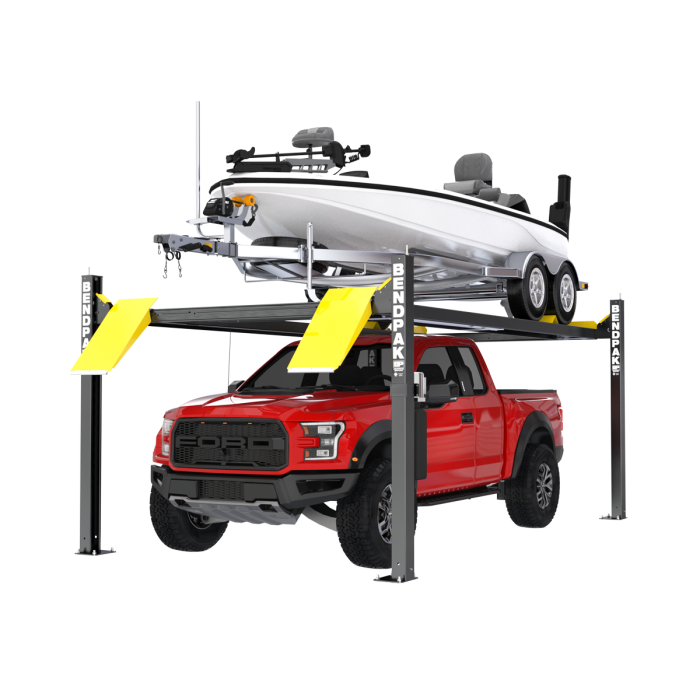
The Challenger 4030, 4040, 4050, 4060, and 4115 cover everything from passenger car storage to 60,000-pound commercial truck work. 4-post lifts require precision leveling that goes beyond what most general contractors can deliver. We use a transit and measure in millimeters at every corner of every runway, adjusting iteratively until the entire platform is within specification. On Iowa’s older concrete floors, which settle unevenly over decades, this leveling process often takes longer than the mechanical installation itself.
Scissor Lifts
Scissor lifts, including alignment-ready models, are the most complex surface-mount installation we perform. Our scissor lift installation checklist runs 82 steps. The equalization process alone — ensuring both sides of the lift rise at the same rate — varies by manufacturer and model. Improper equalization creates a tilting platform that is both dangerous and useless for alignment work.
Inground Lifts
Inground lifts require the most advance planning. The pit must be excavated and poured before the building is finished, or you are cutting into an existing floor — which means dealing with in-floor heating, drain piping, and structural reinforcement. We coordinate with concrete contractors and general contractors to get the pit dimensions, drainage, and waterproofing right before the lift hardware arrives.
Why Professional Car Lift Installation Matters
The lift manufacturers publish installation manuals for a reason. Those manuals specify anchor bolt torque values, hydraulic fluid grades, electrical circuit requirements, safety lock adjustment procedures, and load test protocols. Skipping any of these steps creates risk that compounds over time.
We see the consequences of amateur car lift installation Iowa shops sometimes attempt. Anchor bolts torqued with an impact gun instead of a calibrated torque wrench — overtightened, cracking the concrete around the hole. Hydraulic systems filled with the wrong fluid — seals degrade within months. Power units wired to undersized circuits — breakers trip under load, or worse, wiring overheats. Safety locks that were never adjusted — they engage intermittently or not at all.
Professional installation is not about convenience. It is about safety, longevity, and compliance. ALI (Automotive Lift Institute) certification standards require that lifts be installed according to manufacturer specifications. Insurance carriers and OSHA inspectors look at installation quality when assessing shop compliance. A lift that was not professionally installed is a citation waiting to happen.
What Makes Iowa Installations Unique
Iowa presents specific challenges that installers from other regions may not anticipate.
Climate and concrete. Iowa’s freeze-thaw cycles are hard on concrete. A slab that tested at 3,000 PSI when it was poured may have deteriorated over twenty years of temperature swings, road salt exposure, and water infiltration. We test existing concrete before every installation, and we frequently find slabs in older Iowa shops that need reinforcement or replacement before a lift can be safely anchored.
Building stock. Many Iowa shops occupy buildings that were built decades ago for agricultural or general commercial use, not automotive service. Ceiling heights that are fine for storage are too low for a standard 2-post lift. Electrical panels that serve a warehouse cannot handle a 208V power unit without an upgrade. Floor drains sit exactly where a lift column needs to go. We deal with these constraints on nearly every installation in older Iowa buildings.
In-floor radiant heat. Iowa winters drive demand for heated shop floors. In-floor radiant heat systems run tubing through the concrete slab, and drilling an anchor bolt through a heat tube creates an expensive repair and a cold spot in the floor. We require customers to mark heating tube locations before we drill, and we limit anchor bolt depth to 5 inches in heated-floor installations to avoid the tubing.
Rural access. We install lifts in towns that are 200 miles from our Ames headquarters. Shops in Sioux City, Dubuque, Burlington, and Spencer need the same quality installation as shops in Des Moines. We plan travel and logistics so that every installation gets the same process regardless of location. A lift in a small-town Iowa shop is just as critical to that shop’s operation as a lift in a 30-bay dealership.
Our Service Area: All 99 Iowa Counties
We are not a Des Moines-only operation. Car lift installation Iowa coverage from Auto Lift Services spans the entire state. We install lifts in every major metro and every small town with a shop that needs one.
Our most active installation areas include Des Moines and the central Iowa corridor, Cedar Rapids and the I-380 corridor, the Quad Cities along the Mississippi, Sioux City and western Iowa, Iowa City and Johnson County, Waterloo-Cedar Falls in the northeast corridor, Council Bluffs and the Omaha metro, Ankeny and the northern suburbs, Dubuque and the tri-state region, and West Des Moines and the western suburbs.
We also serve every county between these metros. If you have a shop in Iowa and you need a lift installed, we will get there.
The Installation Process Start to Finish
Every car lift installation Iowa project follows the same process. No shortcuts.
Step 1: Site Assessment. We visit the shop, measure concrete thickness and test compressive strength, verify ceiling height at the planned lift location, check electrical panel capacity and circuit availability, locate in-floor obstructions (heat tubing, drains, conduit), and confirm bay dimensions.
Step 2: Lift Selection. Based on the site assessment, we match the right lift to the shop’s needs and physical constraints. If the ceiling is 11 feet 6 inches, we are not installing a standard 2-post — we are recommending the Challenger CLFP9. If the concrete is only 3.5 inches thick, we discuss reinforcement options before proceeding.
Step 3: Scheduling and Delivery. We coordinate delivery so the lift arrives when the bay is ready. We do not ship lifts to sit in a parking lot for two weeks.
Step 4: Installation. Positioning, anchor drilling, hydraulic connection, electrical hookup, safety lock installation, and equalization. Every step follows the manufacturer’s procedure and our own checklists.
Step 5: Testing and Certification. Full operational test under load. Safety locks tested at every position through multiple raise-and-lower cycles. Leveling verified. Hydraulic pressure checked. Electrical connections confirmed. We do not leave until the lift is working correctly and your team has been walked through daily inspection procedures.
Beyond Installation: Ongoing Support
Installation is day one. We also provide annual inspections, preventive maintenance, cable and chain replacement, hydraulic cylinder rebuilds, safety lock adjustments, and emergency repair service across all 99 counties. When a lift goes down in your shop, we respond because we know what downtime costs.
For technical guidance on concrete preparation, read our concrete requirements guide. For a breakdown of what electrical work your lift will need, see our electrical requirements guide.
Get Your Lift Installed Right
Whether you are equipping a new shop, replacing aging lifts, or adding capacity to an existing facility, professional car lift installation Iowa service from Auto Lift Services is the difference between equipment that performs safely for decades and equipment that creates problems from day one. We sell it, we install it, we stand behind it.
Call 800-674-9302 | Email [email protected] | Browse lifts at store.autoliftserv.com

Josiah Ragsdale
Founder, Automotive Lift Services
Josiah has been installing, repairing, and inspecting automotive lifts since he was 18 years old. He founded Automotive Lift Services in 2019 after years of seeing lifts installed wrong, never inspected, and putting technicians at risk. His team now services all 50 states from their Iowa headquarters. Read more
Car Lift Installation Iowa – Questions & Answers
Can you move or reinstall a lift I already own?
Yes. We relocate and reinstall lifts, including re-anchoring and safety checks.
Do you install the lift or just deliver it?
We do install coordination – a real crew, not a drop-shipper. Install is deposit-based and scheduled around your shop.
What do you need from me before install day?
Confirmed ceiling height, floor thickness, bay layout, and electrical. We verify all of it in a Fit Check before we schedule.
Recent work: For example, we installed a ROTARY SPOA lift for an Iowa shop for $60,824 (a real 2025 job).
Ready to schedule car lift installation iowa? Call 800-674-9302 and we will start with a Fit Check.
Our Clients Include: