


Annual Lift Inspection for Dealerships: What OSHA Requires, What We Find, and Why 5,786 Inspections Tell the Real Story
An annual lift inspection is not optional for a dealership. OSHA’s General Duty Clause requires employers to provide a workplace free of recognized hazards, and OSHA references ANSI/ALI ALOIM-2020 (the Automotive Lift Institute’s standard for inspection and maintenance) as the benchmark for lift safety compliance. When an OSHA inspector walks into your service department after a lift incident, the first question is whether the lift was inspected within the last 12 months by a qualified inspector. If the answer is no, the conversation gets very expensive very fast.
We are Auto Lift Services. We have completed 5,786 lift inspections across Iowa and we perform annual lift inspection work for dealerships, fleet facilities, and independent shops throughout our service area. We handle dealership construction and equipment end-to-end — architecture and design, construction management through our general contracting partners, all service department equipment, and service after the sale with a two-year warranty on the building and everything in it. Inspection and ongoing service are part of that full scope.
What the Standard Requires
ANSI/ALI ALOIM-2020 establishes the inspection requirements for all automotive lifts including two-post, four-post, inground, scissors, parallelogram, and mobile column lifts. The standard specifies:
Annual inspection frequency. Every lift must be inspected at least once every 12 months. High-use lifts or lifts in harsh environments (salt air, extreme temperatures, chemical exposure) should be inspected more frequently — semi-annual inspection is recommended for these conditions.
Qualified inspector. The inspection must be performed by a person qualified by training and experience to inspect automotive lifts. ALI offers a Lift Inspector Certification Program that validates inspector qualifications. While OSHA does not explicitly require ALI certification, using an ALI-certified inspector provides the strongest defensible position in the event of an OSHA inquiry.
Written documentation. The inspection must produce a written record including the date, inspector identification, lift identification (serial number, model, location), findings, and any recommended corrective actions. This documentation must be retained by the lift owner. We maintain records of every annual lift inspection we perform and provide the dealer with a copy for their files.
What Gets Inspected
A thorough annual lift inspection covers every component that affects the safe operation of the lift. Here is what our inspectors evaluate on every lift, every time.
Structural Integrity
Column condition. Visual inspection of both columns for cracks, bends, dents, corrosion, or weld defects. Columns carry the full weight of the lifted vehicle and any structural compromise is a condemning condition. We check the full height of each column, paying particular attention to the base weld (where the column meets the base plate) and the carriage track area (where the carriage rides against the column).
Carriage condition. The carriages — the components that travel up and down the columns and hold the lifting arms — are inspected for cracks, wear in the guide surfaces, and proper fit against the column track. Excessive play between the carriage and column indicates worn guide pads that should be replaced.
Arm condition. Lift arms are checked for bends, cracks, and wear at the pivot points. Arms that have been overloaded may show permanent deformation. Telescoping arms are checked for smooth operation and secure locking at the extended position.
Hydraulic System
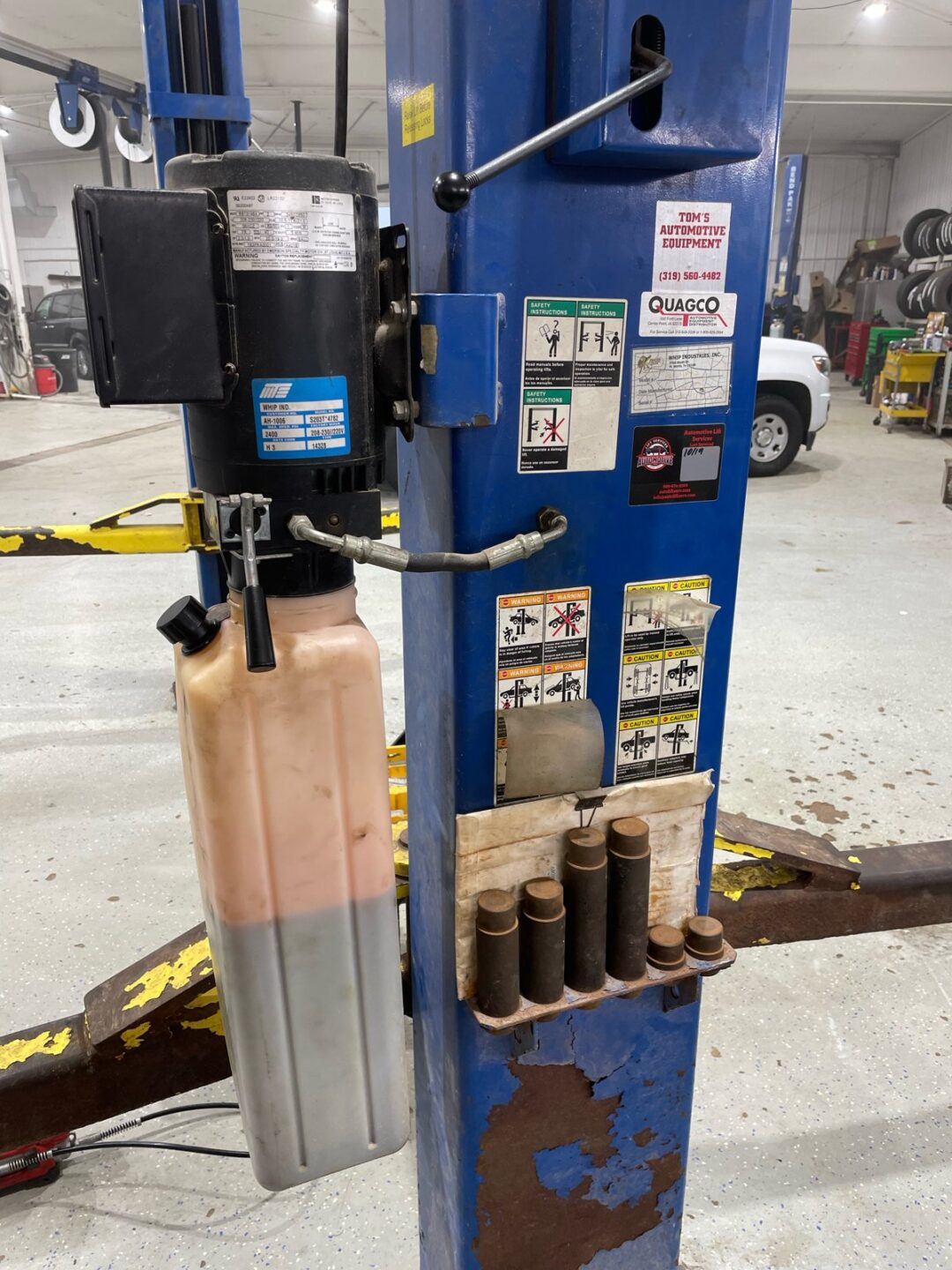
Reservoir and fluid. Fluid level, fluid condition (color, clarity, contamination), and reservoir integrity. Discolored or cloudy fluid indicates contamination or breakdown. Low fluid indicates a leak.
Pump and motor. Operational test: the pump should build pressure smoothly and the motor should run without excessive noise or vibration. Unusual sounds indicate bearing wear, cavitation, or pump vane damage.
Cylinders. Each annual lift inspection includes close examination of the hydraulic cylinder shafts for scoring, pitting, chrome peeling, and seal leakage. A scored shaft will destroy a new seal within weeks — shaft damage must be addressed before seal replacement will be effective.
Hoses and fittings. All hydraulic hoses checked for abrasion, cracking, bulging, kinking, and fitting security. Hoses older than 7 years should be replaced regardless of visible condition per most manufacturer recommendations.
Valves. The lowering valve is tested for proper descent speed control. A lift that descends too fast has a valve issue that could result in an uncontrolled drop. The safety (check) valve is verified to hold the lift at height with the power off.
Safety Locks
This is the most critical safety component on any lift. The mechanical safety locks are the last line of defense between a hydraulic failure and a vehicle falling on a technician.
Engagement test. The lift is raised to each lock position and the locks are verified to engage positively. Each lock position must engage fully — partial engagement means the pawl tip is worn or the rack teeth are worn, and the lock may not hold under load.
Pawl and rack condition. The lock pawl (the moving component) and the column rack (the stationary teeth) are inspected for wear, rounding, cracking, and corrosion. Worn teeth reduce the engagement depth and the holding capacity of the lock.
Release mechanism. The lock release must function smoothly. A release that sticks or requires excessive force tempts technicians to defeat the locks — which is the single most dangerous behavior possible with a lift.
Cables and Chains
Equalization cables. On lifts with cables that synchronize the two sides of the lift, each cable is inspected for broken strands, bird-caging (where strands separate from the core), kinking, corrosion, and proper adjustment. A single broken strand is a condemning condition under ANSI/ALI ALOIM. The lift must be taken out of service until the cable is replaced.
Chains. On lifts using equalization chains, each link is checked for elongation, cracking, and corrosion. Chain elongation beyond the manufacturer’s specification indicates wear that has reduced the chain’s load capacity.
Sheaves and pulleys. The sheaves that the cables ride over are inspected for groove wear, bearing play, and alignment. A worn sheave groove causes accelerated cable wear and can cause the cable to jump the sheave under load.
Electrical System
Motor and controls. The electric motor is checked for proper operation, unusual noise, overheating, and proper rotation. Control circuits including up/down switches, limit switches, and safety interlocks are tested for correct function.
Wiring. All visible wiring is checked for damage, deterioration, proper routing, and secure connections. Rodent damage to wiring is more common than most dealers realize, especially in lifts that sit idle over weekends.
Ground. The equipment grounding connection is verified. A lift with a compromised ground creates an electrocution risk.
Anchoring
Bolt condition. Every anchor bolt is checked for tightness and condition. Loose anchor bolts are among the most common findings in our annual lift inspection work, particularly on two-post lifts in older concrete or concrete that was not properly specified for lift loads.
Concrete condition. The concrete around each anchor point is inspected for cracking, spalling, and deterioration. A bolt that is tight in crumbling concrete is not actually anchored. Concrete repair or lift relocation may be necessary.
Environmental Compliance
Fluid containment. Any fluid leak from the lift system must be contained to prevent environmental contamination. Drip pans, absorbent materials, or secondary containment may be needed for lifts with active leaks until repairs are completed.
Disposal. Used hydraulic fluid must be disposed of as waste oil per EPA and state regulations.
Common Findings From 5,786 Inspections
After completing 5,786 lift inspections, we have a substantial dataset on what actually fails and how often. The most common deficiencies we find during an annual lift inspection, in approximate order of frequency:
1. Worn or missing lubrication. The most common finding by far. Dry pivot points, ungreased bearings, and corroded contact surfaces. Lubrication is the cheapest maintenance item and the most frequently neglected.
2. Cable wear. Frayed strands, bird-caging, and corrosion on equalization cables. This is an immediate safety issue. One broken strand condemns the lift.
3. Leaking cylinders. Slow seepage at cylinder seals that progresses over months until the lift will not hold height. Often visible as fluid staining on the cylinder shaft or pooling at the base.
4. Loose anchor bolts. Particularly common on two-post lifts that see daily use. Thermal cycling, vibration, and the repeated loading/unloading cycle all work to loosen anchors over time. In older concrete (20+ years), the concrete itself may have deteriorated around the anchors.
5. Safety lock wear. Rounded pawl tips, worn rack teeth, and sticky release mechanisms. This is the finding that keeps us up at night because a failed safety lock during a hydraulic failure is how a technician gets killed.
6. Electrical connection corrosion. Especially in coastal or humid environments. Corroded terminals increase resistance, causing overheating, motor damage, and intermittent control failures.
7. Hose deterioration. Cracking, bulging, and abrasion on hydraulic hoses that are past their service life but still holding pressure — for now.
8. Arm pad deterioration. Cracked, compressed, or missing rubber arm pads that reduce the contact area between the lift arm and the vehicle.
Cost of an Annual Lift Inspection
$200 to $400 per lift depending on the lift type, location, and the number of lifts at the facility. Larger facilities with more lifts benefit from volume efficiencies — the inspector is already on site, so the per-lift cost decreases.
For a 12-lift dealership service department, the annual inspection cost is $2,400 to $4,800. For context, the cost of a single OSHA citation for a lift safety violation starts at $16,131 for a serious violation (2024 rate, adjusted annually) and can reach $161,323 for a willful violation. A single annual lift inspection program pays for itself the first time OSHA walks through the door.
Frequency: Annual Minimum, Semi-Annual Recommended
ANSI/ALI ALOIM specifies annual inspection as the minimum frequency. However, we recommend semi-annual inspections for:
High-use bays. A lift cycling 30 to 40 times per day accumulates more wear in six months than a lift cycling 10 times per day accumulates in a year.
Coastal and humid environments. Salt air accelerates corrosion on cables, fittings, and structural components. What takes 12 months to develop in Iowa can take 6 months in a Florida coastal shop. (See also: Florida dealership construction.)
Older lifts. Lifts beyond 10 years of age have more wear-related deficiency potential and benefit from more frequent inspection.
Lifts with previous deficiencies. A lift that had a finding corrected at the last inspection should be re-inspected at the corrected component within 6 months to verify the repair is holding.
What Happens After the Inspection
An annual lift inspection that finds deficiencies generates a corrective action list. The urgency of each item determines the timeline for repair.
Immediate (condemning conditions). Broken cable strands, failed safety locks, structural cracks, and other conditions that create an immediate safety hazard require the lift to be locked out and tagged out until repaired. No exceptions. No “we will get to it next week.” The lift is out of service now.
Priority (within 30 days). Active hydraulic leaks, worn arm pads, loose anchor bolts, and deteriorated hoses that are not yet immediate hazards but will become hazards without timely repair. These items should be scheduled within 30 days of the inspection.
Maintenance (within 90 days). Lubrication, minor adjustments, cosmetic issues, and early-stage wear that should be addressed in the next maintenance cycle.
We provide clear priority classifications with every inspection report so the dealer knows exactly what needs immediate attention versus what can be scheduled.
One Team From Install to Inspection
We install the lifts. We warranty the lifts. We inspect the lifts. We service the lifts. Architecture, construction management, equipment, and every annual lift inspection for the life of the equipment — all through one team with a two-year warranty on the building and everything in it, followed by ongoing service and maintenance programs.
5,786 inspections and counting. Contact us to schedule yours.
Related Articles
- Fleet Maintenance Facility Construction
- Vocational Auto Shop Construction
- Airport Vehicle Maintenance Equipment

Josiah Ragsdale
Founder, Automotive Lift Services
Josiah has been installing, repairing, and inspecting automotive lifts since he was 18 years old. He founded Automotive Lift Services in 2019 after years of seeing lifts installed wrong, never inspected, and putting technicians at risk. His team now services all 50 states from their Iowa headquarters. Read more
Lift Inspections – Questions & Answers
Do you do annual lift inspections?
Yes. We perform ALI-style annual inspections and apply a dated certification sticker your insurer and OSHA expect.
Why does my insurance want a lift inspection?
Insurers and safety programs require documented annual inspection of automotive lifts. We provide the inspection and the sticker.
What happens if a lift fails inspection?
We document what failed and quote the repair. Most issues – cables, locks, seals – are straightforward fixes.
Due for lift inspections? Call 800-674-9302 to get on the inspection schedule.
Our Clients Include: