


Scissor lifts deliver lifting power from below the vehicle rather than alongside it, giving technicians unobstructed access to the entire undercarriage. From mid-rise models used for quick oil changes to full-rise units handling exhaust, brake, and suspension work, scissor lifts are essential equipment in Iowa shops. When the scissor mechanism wears, hydraulics leak, or the platform goes out of level, you need scissor lift repair Iowa service from technicians who understand these specialized machines. Auto Lift Services has the expertise.
How Scissor Lifts Differ from Column Lifts
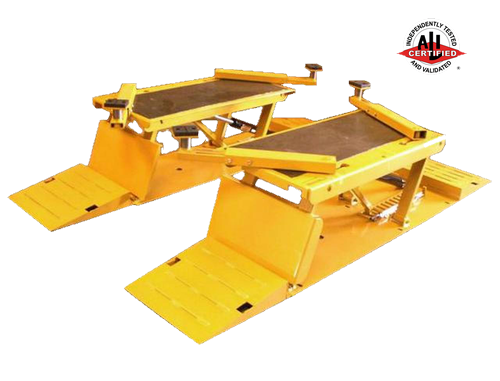
Before diving into repairs, it helps to understand what makes scissor lifts unique. Instead of carriages riding up columns, scissor lifts use a crisscross mechanism of steel arms that fold flat and expand upward. Hydraulic cylinders push the mechanism open, raising the platform. This design creates a low-profile unit that requires no overhead structure and minimal floor space.
The Challenger SX14 delivers 14,000 pounds of capacity in a full-rise scissor configuration, making it suitable for truck and SUV service. Mid-rise scissor models like the Challenger SRM10 provide 10,000 pounds of capacity with a lower maximum height, perfect for tire shops and quick service operations. Both designs require different repair approaches than column lifts, which is why you need technicians experienced in scissor-specific service.
Scissor Mechanism Wear
The scissor arms are the defining feature and the primary wear point of these lifts. Each arm pivot carries a significant portion of the vehicle load through pins, bushings, and bearings. Over thousands of cycles, these pivot components wear and develop play.
Symptoms of scissor mechanism wear include rattling or clunking during lifting and lowering, visible lateral movement in the platform, uneven rising where one end leads the other, and squealing from dry or worn pivot bushings. Our scissor lift repair Iowa technicians measure pivot wear at every hinge point. We replace pins and bushings in matched sets to maintain proper geometry. On lifts with roller bearings at the pivot points, we inspect rollers for flat spots and replace them when wear exceeds manufacturer limits.
The scissor arms themselves are structural components that rarely fail unless corrosion has weakened them. In Iowa, we inspect arm surfaces for pitting and section loss, particularly on lifts installed in recessed pits where standing water and road salt create an aggressively corrosive environment.
Hydraulic Cylinder Service
Scissor lifts rely on one or more hydraulic cylinders to drive the mechanism. Because the cylinder must generate enough force to lift the entire platform plus vehicle weight through the mechanical disadvantage of the scissor geometry, these cylinders operate at higher pressures than comparably rated column lifts.
Common hydraulic cylinder issues include rod seal leaks showing as oil weeping at the cylinder rod, piston seal bypass causing slow drift under load, scored or pitted cylinder rods from debris exposure, and bent rods from side-loading during operation. We rebuild scissor lift cylinders on-site in most cases. The repair involves disassembling the cylinder, inspecting the bore and rod surfaces, replacing all seals, and reassembling to factory specifications. Severely damaged cylinders are replaced with new or remanufactured units. Our scissor lift repair Iowa service covers every scissor lift brand on the market.
Platform Level Issues
A scissor lift platform must remain level within tight tolerances as it rises. Unlike a 4-post lift where cable adjustments equalize the runways, scissor lift leveling depends entirely on the mechanism geometry and hydraulic synchronization.
When a scissor lift goes out of level, the cause is usually uneven pivot wear causing one side to lag, hydraulic flow imbalance in dual-cylinder systems, bent or distorted scissor arms, or worn slider guides on the frame rails. Our technicians diagnose level issues by measuring platform height at all four corners at multiple lift heights. The root cause determines the repair, whether it involves pivot component replacement, hydraulic flow adjustment, or frame rail service.
Frame Corrosion on Recessed Pit Lifts
Full-rise scissor lifts are often installed in recessed pits so the platform sits flush with the shop floor when lowered. This is the preferred configuration for drive-through service lanes and alignment bays. In Iowa, pit-mounted scissor lifts face an aggressive corrosion challenge that surface-mounted lifts avoid.
Iowa’s high water table, particularly in river valley communities along the Des Moines, Iowa, Cedar, and Mississippi rivers, can introduce groundwater into lift pits. Combined with road salt washed off vehicles and shop cleaning chemicals, this creates standing corrosive solution that attacks the scissor mechanism, frame rails, hydraulic lines, and electrical components from below.
During scissor lift repair Iowa service on pit-mounted lifts, we inspect the pit drainage system, check sump pumps if installed, evaluate corrosion on all below-grade components, and recommend protective measures. These may include improved drainage, corrosion-resistant coatings, sacrificial anodes, or waterproofing treatments for the pit walls and floor.
Rubber Pad Replacement
The rubber contact pads on scissor lift platforms are the interface between the lift and the vehicle. These pads absorb vibration, prevent vehicle damage, and provide friction to keep vehicles positioned. Over time, rubber pads compress, crack, harden, and lose their grip.
Pad replacement is straightforward but important. Worn pads allow metal-to-metal contact that damages both the vehicle and the lift platform. Hardened pads lose their vibration-dampening properties, transmitting operational shock through the vehicle. We stock replacement pads for Challenger, Rotary, BendPak, and other major scissor lift brands and replace them as part of routine maintenance.
Safety Lock Inspection
Scissor lifts use mechanical locks to hold the platform at working height. The lock design varies by manufacturer. Some use a ladder-bar system similar to column lifts, while others use a platform rest or mechanical prop that physically supports the platform.
Lock systems on scissor lifts require regular inspection because they are the backup safety system if the hydraulics fail. Our technicians verify positive lock engagement at every designed position, test the lock release mechanism, inspect lock components for wear and corrosion, and verify that the lock supports the full rated capacity.
Iowa’s salt environment accelerates lock component corrosion, particularly on pit-mounted lifts where locks are exposed to the same below-grade conditions as the scissor mechanism. We treat lock components with corrosion inhibitors during every scissor lift repair Iowa service visit.
Power Unit and Control System Service
Scissor lift power units work harder than column lift power units because the scissor mechanism requires more hydraulic pressure as the lift approaches full height. This means higher operating temperatures, faster wear on pump components, and greater demand on the electric motor.
We service power units by testing motor amp draw under load, measuring pump output pressure and flow rate, inspecting and replacing filters, analyzing fluid condition, testing solenoid valves and flow controls, and verifying control switch operation. For shops with high-cycle scissor lifts handling dozens of vehicles per day, we recommend shorter service intervals than the manufacturer’s standard schedule.
Serving Iowa Shops Statewide
Auto Lift Services provides scissor lift repair Iowa service to shops, dealerships, quick lube facilities, and fleet operations across all 99 counties. We service Challenger, Rotary, BendPak, Atlas, Blazer, and every other brand. Our technicians carry common scissor lift wear parts to resolve most issues in a single visit.

Josiah Ragsdale
Founder, Automotive Lift Services
Josiah has been installing, repairing, and inspecting automotive lifts since he was 18 years old. He founded Automotive Lift Services in 2019 after years of seeing lifts installed wrong, never inspected, and putting technicians at risk. His team now services all 50 states from their Iowa headquarters. Read more
Scissor Lift Repair – Questions & Answers
My lift is leaking hydraulic fluid – can you fix it?
Yes. Hydraulic leaks – hoses, cylinders, fittings, and seals – are our most common repair. We find the source instead of just topping off fluid.
It won't go up (or won't come down). What's wrong?
Usually a cable, valve, or hydraulic holding problem. A lift that will not lower is often a stuck lock or a valve issue, both routine fixes for us.
Do you work on lifts you didn't sell?
Yes. We repair the common brands – Rotary, Forward, Challenger, BendPak, Atlas, Mohawk and more – regardless of where you bought the lift.
Recent work: For example, we installed a SL210 lift for an Iowa shop for $58,075 (a real 2024 job).
Down a bay? Get scissor lift repair on the schedule. Call 800-674-9302 with the brand and symptom and we will get you running.
Our Clients Include: