
Car Lift For Sale Bismarck ND
A dealership service manager searching for a car lift for sale bismarck nd is rarely thinking about the same things as a hobbyist buying a two-post for a home garage. Seasonal storage rotation, insurance compliance, and technician liability change the entire equation. If you’re managing a service drive in Bismarck that swells with trade-ins and loaner vehicles every fall and winter, the lift you choose has to do double duty: safely storing vehicles for months at a time while still being ready for a full diagnostic or tire rotation at a moment’s notice. This piece looks at that scenario through a technical lens — real dimensions, ALI Gold certification requirements, and the engineering trade-offs that matter when a car lift for sale in Bismarck ND needs to hold up to dealership-grade duty cycles, not just weekend wrenching.
Why Seasonal Storage Changes the Lift Spec
Most buyer’s guides for a car lift for sale in Bismarck ND focus on a single-use case: a technician lifting a vehicle for an hour or two of service work. Dealership storage is different. In a Bismarck service drive, vehicles often sit raised for weeks at a stretch during the shoulder seasons when lot space is tight — think trade-ins waiting on reconditioning, loaner fleets being rotated out, or seasonal inventory like convertibles and off-road trucks that customers don’t want sitting on wet pavement all winter. That means the lift isn’t just a service tool; it’s functioning as vertical storage infrastructure.
This changes what matters in a spec sheet. Duty cycle ratings that assume intermittent use don’t tell you much about how a lift’s hydraulic seals, locking mechanisms, and arm restraints hold up under sustained load for days or weeks. A lift that’s rated for 9,000 lbs of lifting capacity in a two-minute cycle isn’t automatically rated for safe, unattended long-term hold — that’s a separate engineering question, and it’s one every service manager should ask a supplier directly before committing capital.
There’s also a liability dimension. A vehicle parked overhead for an extended period, in a shop with other staff and customers moving underneath or nearby, needs a locking system that fails safe over time, not just at the moment of lift. This is where ALI Gold certification becomes more than a checkbox — it’s the difference between a lift built for occasional use and one engineered for continuous dealership-grade duty.
What ALI Gold Certification Actually Verifies
The Automotive Lift Institute’s Gold certification program is the industry’s third-party validation that a lift meets ANSI/ALI ALCTV safety standards — but the details matter more than the badge. Gold certification requires annual re-inspection, not a one-time stamp, which means the manufacturer has to keep proving the lift design holds up over its service life. For a dealership evaluating a car lift for sale in Bismarck ND for long-duration storage use, that annual re-verification is exactly the kind of ongoing assurance that matters, since it covers structural integrity, locking mechanism reliability, and hydraulic system safety under real-world conditions — not just factory-fresh performance.
Certification also covers the load-holding devices specifically: mechanical locks, safety latches, and the redundancy built into hydraulic circuits. In a storage context, these are the components doing the most work, since the vehicle may sit raised through several freeze-thaw cycles or temperature swings inside an unheated or lightly-heated bay — a real consideration for a North Dakota winter.
When you’re comparing quotes, ask suppliers point-blank whether the specific model and configuration you’re pricing carries current ALI Gold certification, not just the brand generally. Certification is often model- and even revision-specific. A reputable seller should be able to produce the certification documentation on request, and if they can’t, that’s a signal to look elsewhere — especially for a dealership application where a liability claim tied to an uncertified lift would be far costlier than the price difference between certified and uncertified equipment.
Two-Post vs. Four-Post for Storage-Heavy Service Drives
For dealerships weighing a car lift for sale in Bismarck ND primarily for storage duty, the two-post versus four-post decision looks different than it does for a pure repair shop. A two-post lift frees up floor space and allows full underside access, which matters if reconditioning work happens on the same lift used for storage. But holding a vehicle raised on a two-post for days at a time puts continuous load on the arm locks and column anchoring — dimensions and anchor bolt specs from the manufacturer need to be followed exactly, especially on older concrete pads common in older Bismarck service bays.
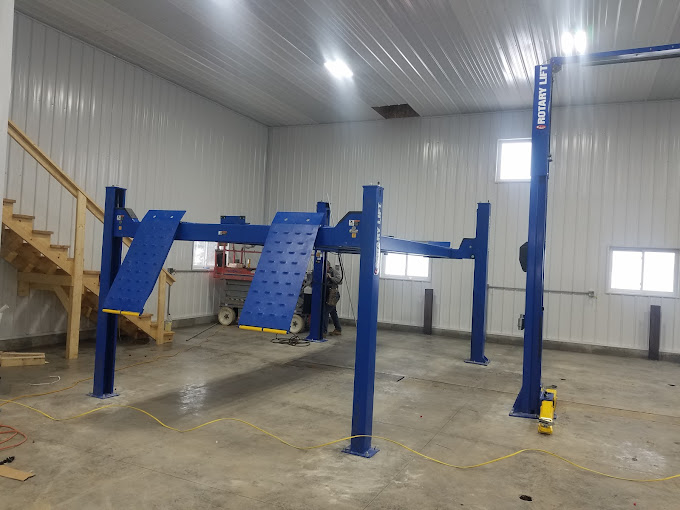
Four-post lifts, by contrast, are often better suited to pure storage because the vehicle rests on its own wheels on a runway deck rather than being held by arms at four contact points. This distributes weight more like the vehicle sitting on the ground, which reduces long-term stress on any single locking mechanism. Runway lengths in the 189–220 inch range and overall widths near 100–114 inches are common for four-post configurations that need to handle both passenger cars and light trucks in a mixed dealership fleet. Platform height when raised typically lands in the 60–82 inch range depending on model, which needs to be checked against bay ceiling clearance before ordering.
Many dealership service managers ultimately run a hybrid setup: two-post lifts on active bays for repair work, and four-post lifts along a back wall or secondary bay dedicated to seasonal storage rotation. If you’re weighing that layout, our parts lookup page can help confirm anchor and adapter compatibility across both lift types before you commit to a floor plan.
Real Dimensions That Matter for a Bismarck Service Bay
Dimensions on paper mean little until they’re checked against an actual Bismarck facility. Ceiling height is the first constraint — many dealership service bays built in the 1990s and early 2000s have clearances between 12 and 14 feet, which limits maximum lift height to roughly 130–140 inches once you subtract for the vehicle itself and safety clearance above. A two-post lift with a maximum lifting height near 139 inches, paired with a baseplate rather than overhead configuration, is a common fit for bays with lower ceiling trusses or HVAC ductwork running along the roofline — a configuration we see requested often for buildings that can’t accommodate an overhead beam.
Floor thickness is the second constraint that gets overlooked. Anchoring a two-post lift rated for 9,000–12,000 lbs of capacity generally requires a minimum of 4 inches of solid, unreinforced concrete free of cracks or expansion joints near the anchor points — more if the slab is older or has visible spalling. Dealerships with bays poured decades ago should budget for a core sample or at minimum a visual inspection before ordering, since retrofitting a thin or compromised slab adds real cost and delay.
Column spacing and drive-through clearance also matter for storage-heavy use. A two-post lift with roughly 100–104 inches of clear width between columns accommodates most passenger vehicles and light trucks, but dealerships storing larger SUVs or extended-cab pickups should confirm outer column width doesn’t crowd adjacent bays when the vehicle is loaded on and off. These are the kinds of dimensional checks that separate a smooth installation from a costly rework, and they’re worth confirming against your actual floor plan before finalizing any car lift for sale in Bismarck ND.
Duty Cycle vs. Capacity: Reading the Spec Sheet Correctly
Lifting capacity — the number most buyers fixate on — tells you the maximum weight a lift can raise, but it doesn’t tell you how the lift performs under sustained load. For dealership storage use, duty cycle and static load-holding specs deserve equal attention. A lift rated for a 9,000 lb capacity in intermittent service use should still be checked for its static hold rating and recommended maximum continuous-hold duration, which manufacturers sometimes list separately from the headline capacity number.
Hydraulic cylinder seals are the component most affected by long static holds. Seals designed for frequent cycling (up and down several times a day) behave differently than seals under constant pressure for days or weeks. Ask any supplier quoting a car lift for sale in Bismarck ND for storage use whether the cylinder and seal package is rated for extended static hold, and whether the mechanical locks — not hydraulic pressure alone — are what’s bearing the load once the vehicle is parked and left. A properly engineered lift will always default to mechanical locking engagement for any hold beyond a few minutes, regardless of how long the vehicle stays up.
Ambient temperature also affects hydraulic fluid viscosity, which matters in North Dakota’s swings between summer heat and deep winter cold. If bays aren’t climate controlled, ask whether the manufacturer specifies a cold-weather hydraulic fluid or seal package rated for the temperature range your Bismarck facility actually sees. This is a detail that rarely appears on a basic spec sheet but has real consequences for a lift doing months of seasonal storage duty rather than daily short-cycle service work.
Local Installation and Service Without a Bismarck Storefront
Auto Lift Services is based in Ames, Iowa, and we’re upfront that we don’t operate a physical shop or office in Bismarck. What we do run is a nationwide network of vetted, trained 1099 subcontractor technicians, and for many dealership-scale installs we also fly one of our own Iowa-based technicians out to work alongside the local tech on-site. That combination — a local installer paired with direct ALS oversight — lets us deliver real, hands-on install and service for a car lift for sale in Bismarck ND without pretending to have a storefront we don’t have.
For a dealership installation, that means anchor bolt torque specs, column plumb checks, and ALI Gold certification documentation all get verified in person, not just shipped with a manual and left to chance. Our technicians are trained on the same brands — Amgo, Weaver, BendPak, and others — that show up most often in dealership service drive quotes, and we carry the parts and adapter inventory to support those installs long after the lift is in the ground.
If your Bismarck dealership is comparing quotes for two-post versus four-post storage configurations, our team can walk through actual bay dimensions, floor thickness requirements, and certification documentation before you commit. We’ll also flag when a job calls for a specific configuration — like a baseplate-mounted two-post in a lower-ceiling bay — based on the real constraints of your facility rather than a generic recommendation. You can browse configurations and capacities on our two-post lift collection or review four-post options built for storage-heavy service drives.
Budgeting for Certification, Install, and Long-Term Duty
Dealership service managers evaluating a car lift for sale in Bismarck ND should budget beyond the sticker price of the lift itself. ALI Gold-certified models typically carry a premium over uncertified equivalents, but that premium buys documented, third-party-verified safety performance — a difference that matters when insurance carriers or corporate risk management ask for documentation after the fact. Installation costs for a two-post configuration commonly land in a low-thousands range depending on anchor prep, electrical run length, and whether existing concrete needs remediation before anchoring.
It’s also worth budgeting for periodic recertification inspections rather than treating ALI Gold as a one-time purchase decision. Manufacturers and installers can typically coordinate annual inspections to keep certification current, which matters most for dealerships that may face audits or insurance reviews tied to lift safety.
Finally, factor in the real cost of downtime if a lift fails during a busy storage season. A dealership relying on a single lift for both active service and seasonal storage has no redundancy if that lift goes down for repair. Many Bismarck-area dealerships we’ve quoted end up specifying two lifts — one active-service two-post and one storage-dedicated four-post — specifically to avoid a single point of failure during the exact months when storage demand peaks. Whatever configuration fits your bay, working through the numbers with a supplier who understands dealership duty cycles, not just hobbyist use, is the difference between a lift that holds up for a decade and one that becomes a liability by its third winter.
About the Author
Josiah Ragsdale is the founder of Auto Lift Services. Based in Ames, Iowa, our team installs, services, and stocks parts for every major lift brand — from a home-garage 4-post through 30,000 lb commercial and 40K+ heavy-duty. Have a question or need a quote? Call 800-674-9302 or email [email protected].
Car Lift For Sale Bismarck ND | Seals and Lifts
Improper installation is another potential cause of seal failure. One of the most common mistakes during seal replacement is measuring the seal itself rather than the groove or space where the seal will be placed. If the seal is too large or too small for the groove,...