
Car Lift For Sale Tulsa OK
If you’re a heavy-duty truck shop owner searching for a car lift for sale Tulsa OK, chances are you’re not shopping for a typical 2-post consumer unit — you need real clearance under the frame rails for exhaust work, driveline swaps, and diff service on trucks that weigh a lot more than the average sedan. The good news is that a proper car lift for sale Tulsa OK shop can actually run is a very different animal from what most box stores or online marketplaces list, and the total cost isn’t just the sticker price on the lift itself. Freight, unloading logistics, and site-ready installation all factor into the real number you should be budgeting, and this is where most shop owners get surprised. Below, we break down the full cost stack — from the lift itself through delivery and install — so you know exactly what you’re paying for and why.
Why Truck Shops Need a Different Lift Than the Average Garage
Most searches for a car lift for sale Tulsa OK are aimed at hobbyists and general repair shops lifting 4,500 to 6,000 lb passenger vehicles. A heavy-duty truck shop is solving a completely different problem. Exhaust and driveline work on 1-ton pickups, medium-duty box trucks, and service vans means you need clear, unobstructed access underneath the entire wheelbase — not just the frame rails near the wheels. That usually rules out standard baseplate 2-post units and pushes shops toward extended-height 2-post lifts, wide 4-post drive-on platforms, or in some cases mobile column sets that can lift a truck by the axles and leave the whole underside open.
Weight capacity is the obvious first filter — 10,000 to 14,000 lb rated lifts are common minimums for one-ton and larger trucks, and if you’re servicing anything approaching medium-duty, you’ll want to look at 18,000 lb-plus columns. But capacity alone doesn’t guarantee usable access. Arm reach, post placement, and overall lift width all matter more for driveline and exhaust work than they do for a typical oil-change bay, because you need the arms to clear the diff, the crossmembers, and often dual exhaust runs without repositioning the vehicle mid-job.
This is the piece a lot of comparison shopping misses: two lifts with the same tonnage rating can have very different real-world usability once you’re actually underneath a truck. That’s why shop owners searching for a car lift for sale Tulsa OK should be comparing arm configuration and clearance specs, not just the number on the capacity plate.
Lift Configuration for Exhaust and Driveline Access
For exhaust and driveline-heavy work, an asymmetric 2-post lift with long rear arms and short front arms tends to outperform a symmetric design, because it shifts the load and post position away from the truck’s centerline, leaving more open space along the entire length of the vehicle. Extended-height columns matter too — technicians standing under a raised truck need real head clearance, especially when pulling a driveshaft or dropping an exhaust system as a full unit rather than in sections.
4-post drive-on lifts solve access differently. Because there’s no post structure directly under the vehicle, you get essentially unobstructed access to the full underside, which is a major advantage for exhaust R&R and full driveline swaps. The tradeoff is floor space and the inability to remove wheels easily unless the platform includes rolling jacks or a mid-rise attachment. Many heavy-duty shops actually run both: 2-post lifts for quick-turn service bays and a 4-post for teardown-heavy jobs.
Mobile column lifts are worth a look if your bay layout is irregular or you need to lift trucks with wheelbases that vary widely — a set of columns configured per-vehicle gives you flexibility a fixed 2-post or 4-post can’t match. They also allow full underside access similar to a 4-post setup, which is a real plus for driveline work. If your shop handles a mix of pickups, vans, and the occasional medium-duty box truck, columns can be the most adaptable long-term investment.
Freight Realities: What Actually Arrives on the Truck
A heavy-duty 2-post or 4-post lift doesn’t ship like a pallet of parts — it typically arrives as multiple crates on a flatbed or LTL freight trailer, with individual components easily weighing 400 to 900+ lbs each. Posts, crossbeams, hydraulic units, and arm assemblies are usually crated separately, and the freight carrier’s driver is not going to hand-unload any of it. This is the single most overlooked cost center when shops search for a car lift for sale Tulsa OK and budget only for the lift price itself.
Standard LTL freight terms assume dock-to-dock delivery, meaning the truck shows up with a lift gate at best — and many heavy crates exceed lift gate weight limits entirely. Without a forklift on site, or a loading dock at truck-bed height, you’re looking at a failed delivery attempt, storage fees, or a scramble to find equipment same-day. Shops that have handled equipment freight before know this, but it still catches first-time lift buyers off guard, and it’s a common reason install timelines slip before work even starts.
Site accessibility also affects freight cost quotes upfront. Residential-adjacent shops, tight urban lots, or facilities without a dedicated receiving area often get freight surcharges for redelivery attempts or driver assist. Knowing your dock situation before you request quotes saves real money and prevents delivery delays that push your install date out by weeks.
Unloading and Forklift Logistics
Once freight arrives, unloading is a separate logistics problem from installation. A forklift rated for at least 5,000 lbs with forks long enough to fully support the longest crate is the baseline requirement — undersized forks or a lift truck rated too low is how crates get dropped or damaged during unloading, and warranty claims get complicated fast when that happens. If your shop doesn’t already run a forklift capable of this, renting one for delivery day is almost always cheaper than the alternative.
Positioning matters too. Crates need to come off the freight trailer directly into a staging area close to the install bay, because heavy-duty lift components aren’t easily moved twice. Shops that plan the unloading zone in advance — clear floor space, a path wide enough for the forklift, and no obstruction between the dock and the bay — save real installer time on day one. We’ve seen jobs where the lift arrived, sat pre-staged and unloaded, and installers were able to start mounting hardware within the first hour. We’ve also seen the opposite: crates blocking a shop’s only drive aisle for two days because nobody planned where they’d land.
If your facility doesn’t have forklift access at all, freight brokers can sometimes arrange a delivery truck with an integrated moffett (piggyback forklift), though this typically adds cost and needs to be requested at time of freight booking, not after the truck is already en route.
Site Prep Before Installers Arrive
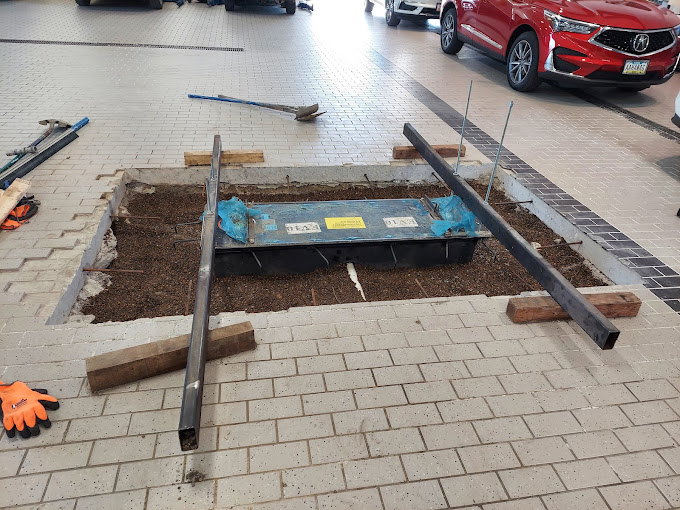
Concrete condition is the first thing any installer checks, and it’s the most common reason install day gets pushed back. Heavy-duty 2-post and 4-post lifts require a minimum slab thickness — often 4 to 6 inches of properly cured concrete, without cracks or patch work near the anchor points — and older truck shop floors don’t always meet that bar without inspection. If your slab is questionable, get it evaluated before the lift even ships, not after installers show up expecting to drill anchors.
Ceiling height and door clearance matter differently for truck shops than passenger vehicle bays. A lift that clears a sedan with room to spare might not give you enough vertical room once a raised one-ton dually or a service van is on the platform. Measure with your actual fleet in mind, including any roof-mounted equipment like ladder racks or exhaust stacks on service trucks.
Electrical and, if applicable, compressed air runs should be planned to the exact bay location before install day. Most 2-post and 4-post lifts run on standard shop voltage, but confirm amperage requirements against your existing panel capacity, especially if you’re adding multiple lifts to one circuit run. Bay layout — enough clearance on both sides for arm swing, plus room for technicians to safely maneuver rolling jacks and driveline components — should be mapped out before the crates arrive, not decided in the moment.
Full Cost Breakdown: Lift, Freight, and Install
When you price out a car lift for sale Tulsa OK for heavy-duty use, think of the total cost in three distinct tiers rather than one number. Tier one is the lift itself — heavy-duty 2-post and 4-post units built for 10,000 lb-plus capacity sit well above entry-level consumer lifts, and extended-height or wide-configuration models push that higher still. Tier two is freight, which scales with crate weight, distance, and whether your site can handle standard dock delivery or needs special equipment. Tier three is installation labor, which for heavy-duty units typically runs longer than a standard 2-post job due to anchor work, alignment, and calibration on larger hydraulic systems.
Shops that skip professional installation to save on tier three often end up paying more later — misaligned posts, improperly torqued anchors, or hydraulic calibration issues can turn into safety liabilities and warranty voids. A heavy-duty lift carrying a truck is not a place to guess on install quality. Factoring all three tiers together, most shop owners find that professional install adds a modest percentage on top of lift and freight cost, but eliminates the risk of redoing work or dealing with a lift that doesn’t hold calibration under repeated heavy loads.
Getting an itemized quote — lift price, freight cost based on your actual dock situation, and install labor scoped to your bay and concrete condition — is the only way to compare offers accurately. Anyone quoting a single flat number without asking about your site is likely leaving out a cost tier that will surface later.
How Auto Lift Services Handles Tulsa Installs
Auto Lift Services is based in Ames, Iowa, and we’re upfront that we don’t run a physical branch office in Tulsa. What we do run is a vetted network of 1099 subcontractor technicians in the Tulsa market who we’ve trained and supported directly, and for heavy-duty jobs — like the multi-post truck-bay installs this article covers — we frequently fly one of our own Iowa-based technicians out to work alongside the local tech on site. That combination gives Tulsa shop owners the benefit of real local hands plus direct oversight from the team that built the install standards in the first place.
We quote the full picture: the lift itself sized to your truck weights and exhaust/driveline access needs, freight scoped to your actual dock and forklift situation, and install labor scoped to your bay’s concrete and electrical condition. If you’re comparing a car lift for sale Tulsa OK against a big-box or marketplace listing, ask whether freight and forklift logistics are even included in the number you were quoted — often they aren’t. For lift selection details specific to configuration and arm reach, our 2-post lift collection and 4-post lift collection break down capacity and clearance specs by model, and our parts lookup page can help if you’re maintaining an existing heavy-duty lift already on your floor.
Call us before you commit to a quote that doesn’t account for site logistics — it’s a five-minute conversation that can save a shop owner real money and a lot of install-day headaches.
About the Author
Josiah Ragsdale is the founder of Auto Lift Services. Based in Ames, Iowa, our team installs, services, and stocks parts for every major lift brand — from a home-garage 4-post through 30,000 lb commercial and 40K+ heavy-duty. Have a question or need a quote? Call 800-674-9302 or email [email protected].
Car Lift For Sale Tulsa OK | Your Starting Point in Hydraulics
Hydraulic systems are complex mechanisms that rely heavily on the efficient conversion and transfer of energy to perform work. The interaction between hydraulic pumps and motors is a critical aspect of these systems, and understanding how each component functions and...